

The sewer overflow known as CSO11, opposite The Arc Leisure Centre, has spilled diluted raw sewage into the River Derwent about 90 times a year on average since monitoring began in 2019. The Environment Agency’s target is around 40 and the government’s target for 2050 is no more than 10 a year.
Several organisations are involved, and it’s not always clear who is responsible for what. This page explains how it fits together. See the below chart which simplifies the inter-relationships.
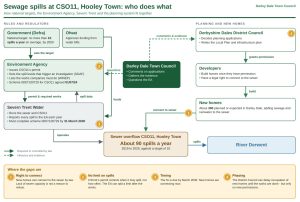
The rules and the regulators
- The Government (Defra) sets the national target: by 2050, no overflow should spill more than 10 times a year on average.
- Ofwat approves the money for improvements, which comes from our water bills.
- The Environment Agency (EA) issues the permit for CSO11. It also sets the spill levels that trigger an investigation, and lists the improvement works water companies must carry out.
- Severn Trent Water (STW) runs the sewer and CSO11, and reports every spill to the Environment Agency each year. It records the sewer at capacity, year after year. It must complete an EA improvement scheme at CSO11 (reference 08ST100729) by 31 March 2030. The scheme was agreed in July 2024.
Planning and new homes
- Derbyshire Dales District Council (DDDC) decides planning applications and writes the Local Plan.
- Developers build homes once they have planning permission. By law they have the right to connect new homes to the public sewer irrespective of its capacity status.
- About 300 new homes are currently planned or expected in Darley Dale. Each one adds sewage and rainwater to the sewer.
Where the two meet
Both the regulators and developers lead to the same place: the sewer that overflows at CSO11. The fix isn’t due until 2030, but new homes are connecting now.
Where the gaps are
- Right to connect. New homes can connect to the sewer by law, even when it’s already full.
- No limit on spills. CSO11’s permit controls when it may spill, not how often. The Environment Agency can add a limit once the improvement scheme is completed.
- The fix is years away. The new homes are being built and others approved now.
- The District Council can delay people moving into new homes until the works are complete, but only when it grants a new permission. Does not apply to existing approvals.
What can DDTC do?
The Town Council doesn’t decide planning applications, but it is consulted on them. It can ask DDDC to use powers that already exist to divert development away from CSO11 and to delay occupation of future new homes until the EA required upgrade is complete, where diversion is not feasible.
Under the current national planning rules (published August 2026), DDTC can rely on:
- The District Council’s own Infrastructure Delivery Plan (July 2026). Paragraph 7.14 says: “There is a need to divert development away from combined sewers where there are known capacity issues.
- Local Plan Policy S10. New development should only be allowed where the infrastructure it needs is available, or will be provided “within an agreed timeframe”. Planning conditions can make sure improvements are completed “prior to occupation”. This 2017 policy still carries full weight under the new national rules.
- Local Plan Policies PD8 and PD9, which guard against overloading the sewer system and against the combined effect of pollution on our rivers.
- Government planning guidance, which says councils should consider phasing development “so it is not occupied until any necessary improvements to the public sewage system have been carried out”.
- The National Planning Policy Framework (August 2026), which says councils should:
- use planning conditions to make development acceptable (policy DM3)
- make sure development suits its location, taking account of the combined effects of pollution (policy P3)
- require sustainable drainage built to the national standards, under which a combined sewer is the last resort for rainwater (policy F8)
- The draft new Local Plan, which goes further: infrastructure must be “phased to align with the capacity of existing networks and planned improvements”.
What will DDTC do?
On every new housing application that drains to CSO11, DDTC will ask the District Council to:
- Get Severn Trent to confirm in writing which overflow the site drains to – for clarity.
- Ask that a condition be added stopping homes being occupied until the CSO11 works are complete, unless spare capacity is proved, citing relevant policies.
- Ask DDC to keep rainwater from the new homes out of the combined sewer wherever possible to minimise spills.
Related documents
Storm Overflows Discharge Reduction Plan 2023
EA WINEP CSO11 Improvement Ref.08ST100729
Derbyshire Dales Infrastructure Delivery Plan July 26 [95]_merge
DDTC_Regulatory_Framework for Sewage Oct 26
DDTC CSO11 Occupation Conditions Policy Basis 4
DDTC will also ask for a sewage requirement on three Darley Dale sites in the new Local Plan, if the Inspector gives it the opportunity during the draft Local Plan examination.
In the draft new Local Plan, each proposed housing site comes with a list of “site-specific requirements” that a developer must meet. For six sites elsewhere in the district – three in Ashbourne, and one each in Doveridge, Matlock and Tansley – the list includes “Ensure sewerage capacity in the receiving network” or very similar wording. The largest Darley Dale site, Stancliffe Quarry (about 80 homes), also has a requirement to “ensure sufficient capacity in the local sewage network”.
The other three Darley Dale sites have no such requirement:
- Land west of Darley Road North – 40 homes
- Land north of Old Hackney Lane – 14 homes
- Land south of Darley Lodge – 25 homes
Given the known problems at CSO11, DDTC will ask for the same requirement to be added to all three, and for new homes on them not to be occupied until the CSO11 improvement works are complete.